Key points at a glance
  • Leave room for breaks and spontaneous changes from the start.
  • A Disney Hotel near the parks makes it easier to take breaks during the day.
  • The free Disneyland Paris Blue Booklet includes sensory ratings for attractions.
  • The Easy Access Card and Priority Card can make your visit easier, but eligibility requirements apply.
  • First Aid centres are among the places where you can take a break. There are also some comparatively quiet areas inside and outside the parks, although these are not official quiet zones.
Frequently asked questions about Disneyland Paris for neurodivergent visitors
  • What support does Disneyland Paris offer neurodivergent visitors?Disney provides resources including the free Blue Booklet with sensory information, accessibility maps and an image library. The Easy Access Card or Priority Card and ear defenders available to borrow can also help if you have the required documentation.
  • Where can I find a quiet place to take time out at Disneyland Paris?You can ask at the First Aid centres for a place to rest. There are currently no designated quiet rooms.
  • Is the Sunflower lanyard recognised at Disneyland Paris?You can wear the Sunflower lanyard. It does not replace the Easy Access Card or Priority Card and does not entitle you to priority access.
zur deutschen Version

Disneyland Paris for neurodivergent visitors

There is a lot to take in at Disneyland Paris: music, sounds, bright colours, changing light levels and people everywhere. What many visitors see as part of the experience can be tiring or overwhelming for neurodivergent people. At the same time, the Disney Parks can bring great joy, especially when the things you are interested in and familiar Disney stories suddenly feel close enough to touch.

Neurodivergence encompasses different ways of perceiving and processing information, including autism and ADHD. The needs associated with neurodivergence vary from person to person. Some people are sensitive to loud noises or crowds, while others find unexpected changes, long waits or too much sensory input at once difficult to cope with. But not every neurodivergent person finds these situations stressful. Many of the tips on this page are also useful for people who do not have a diagnosis but quickly feel exhausted in noisy or highly stimulating environments.

A visit to Disneyland Paris does not have to be the same for everyone. You might want to experience as many attractions as possible, or you might need longer breaks or a quiet place to recover from the sensory input. Needs can also vary considerably within a group travelling together.

Disneyland Paris offers various forms of support and information that can help you before and during your visit. There are also practical ways to make your stay more flexible. This page explains what to consider when planning and what support Disney offers. It also shows you where you can get away from the bustle if you need to.

Tips and support for your visit to Disneyland Paris

Good preparation can help make your holiday at Disneyland Paris more relaxed. It is less about planning every day down to the last detail and more about knowing your own needs and leaving enough room for breaks or spontaneous changes. Disneyland Paris itself offers various forms of support that you can familiarise yourself with before your trip.

Banner Ad Disneyland Paris - book 2027 now. Pro-Tip: Early Booking is usually the cheapest option! Book now for April 2027 to March 2028 with the best price guaranteed Banner Ad mobile view Disneyland Paris - book 2027 now. Pro-Tip: Early Booking is usually the cheapest option! Book now for April 2027 to March 2028 with the best price guaranteed

Well prepared, without overplanning

Before your trip, think about which situations you might find particularly tiring and what helps you cope with them in everyday life. You may be keen to experience certain attractions at Disneyland Paris, but find large crowds or noisy environments difficult. In that case, it can help to focus on the things you most want to do and leave enough room for spontaneous changes.

A hotel close to the Disney Parks can be a big advantage. If you want some time away during the day, you can go back to your room, rest and decide later whether to return to the parks. The Disney Hotels are particularly convenient for this, as most are within walking distance of the parks. Routes and distances do vary from hotel to hotel, though.

Getting there and checking in also deserve some thought. A crowded hotel lobby with loud conversations, music and other guests waiting can be tiring even before your first visit to the Disney Parks. If your hotel offers online check-in, it can at least shorten the check-in process when you arrive.

A little preparation can also help with meals. The restaurants at Disneyland Paris can get crowded and noisy, particularly at the usual mealtimes. At buffet restaurants, also bear in mind the route between your table and the buffet, as well as the constant coming and going of other guests. Table-service restaurants have the advantage that you can stay in your seat during the meal. For both types of restaurant, it is important to  book in good time. If you prefer to decide where to eat on the spur of the moment, fast-food restaurants can be an alternative. Look for seats a little away from the busiest areas, or choose a quieter time to eat. You can look at the menus before your trip. That way, you will already know where to find dishes you like, without risking extra stress once you are there.

Do not assume you need a packed schedule every day of your holiday. The effects of lots of sensory input can build up over several hours or days, even if individual experiences are a lot of fun at first. Some days, half a day in the parks may be enough for you; on others, you may want to stay longer. If you are travelling as a group, it is particularly helpful to agree beforehand that someone can take time out, either alone or with a companion, without everyone else having to change their plans. Doing some things separately may also be an option. That way, those who would rather skip a particular experience are not left waiting around. And it avoids the frustration of someone else having to miss out on too many things.

Pack any aids that have proved helpful to you in everyday life, too. These might include noise-reducing headphones, sunglasses, a stress ball, a fidget toy or an aromatherapy inhaler. Not every aid suits everyone. What matters is what helps you personally when the sensory input becomes too much. You have no doubt already found your own favourite. Put it right at the top of your packing list.

Sensory experiences on rides and at shows

Almost everywhere in Disneyland Paris, several things are happening at once. Music plays through loudspeakers, visitors chat, Disney characters walk past and the next attraction is just around the corner. There are also changes in lighting, smells and plenty to take in visually.

It is worth taking a closer look at the attractions themselves, though. A slow-moving ride does not necessarily mean less sensory stimulation. On Pirates of the Caribbean, for example, you travel through scenes, some of them dark, with moving figures, music, sounds and numerous details all competing for your attention. There is also the distinctive smell of the water. By contrast, It’s a Small World has bright colours, countless moving figures and a tune repeated in different languages throughout the ride.

Fast-paced attractions such as Big Thunder Mountain have their own characteristics, too. Sudden acceleration, darkness, loud sound effects or unexpected movements are part of the experience. Simulators and 3D attractions add moving images and artificially created sensations of movement.

You should not underestimate the queues either. Some take you through dark or confined spaces, while others feature sounds, videos or unexpected details. There are also the people around you to consider, and you cannot always move entirely freely.

Experiences like these may be among your favourites, or you may find parts of them too much. If you would like to get a sense of what to expect beforehand, on-ride videos on YouTube can be helpful. They show you what happens during a ride and many of its distinctive features. However, they can only give a limited sense of the actual sound levels, smells or atmosphere.

Shows and parades can be similar. Many performances involve music that can be very loud, spotlights, special effects and large crowds in confined spaces. The Lion King: Rhythms of the Pride Lands at the Frontierland Theater, for example, combines loud music, singing, acrobatics and lighting effects in an enclosed theatre with several hundred spectators. Mickey and the Magician in Disney Adventure World is similar: an elaborate stage show with special effects, music and surprising moments, also in an enclosed auditorium. Bear in mind that you may not always be able to leave the auditorium easily during a performance.

During evening shows in particular, fireworks, flashes of light and intense sound effects can all happen together, with very large crowds packed into a confined space. For these shows, we recommend a place in one of the paid reserved viewing areas. If you arrive early enough, you have a good chance of getting a spot right by the barrier, so at least there will be no other spectators directly in front of you. This does not necessarily make it quieter, but the action is in front of you and you do not have to keep looking over other people's heads. Alternatively, you can look for a spot a little away from the busiest part of the crowd. You may have more space between you and other visitors there, but you will have to accept a poorer view of the show.

You are the best judge of how intensely you experience these sensations and which of them you might find difficult. An attraction can be exciting and tiring at the same time. Disneyland Paris provides detailed information about the sensory features of many of its experiences. We cover this in more detail in the section on the Blue Booklet.

Easy Access Card and Priority Card

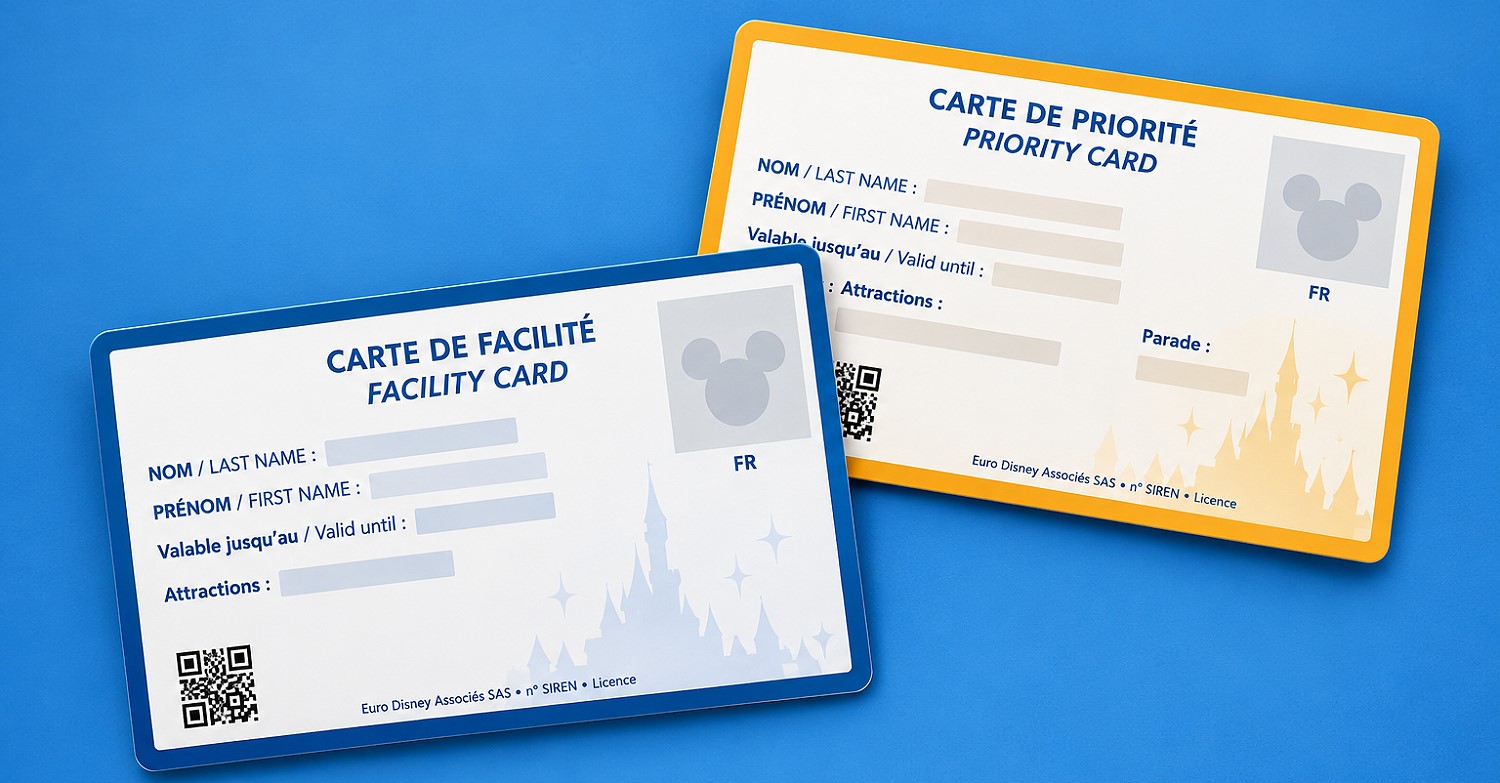
Disneyland Paris' Easy Access and Priority Card for guests with special needs

Disneyland Paris offers two different access arrangements for visitors with certain medical conditions or recognised disabilities: the Easy Access Card and the Priority Card. Both cards can make your visit easier, particularly if you find long waits in crowded or narrow queues difficult.

  • The Easy Access Card is intended for people with certain long-term medical conditions recognised in France. Instead of waiting in the regular queue, you receive a return time at the attraction based on the current waiting time. Until then, you can spend time elsewhere or take a break.
  • The Priority Card is intended for people with an officially recognised disability who can provide proof accepted by Disneyland Paris. It gives you priority access to attractions and certain other experiences without having to use the Easy Access Card's return-time system. However, you may still have to wait.

A diagnosis such as autism or ADHD alone does not automatically entitle you to either card. Eligibility depends on meeting the relevant requirements and providing the necessary evidence.

Our pages on the Easy Access Card and Priority Card explain in detail which documents you need, how to apply for the cards and how they work during your visit.

Sunflower lanyard: a symbol for non-visible disabilities

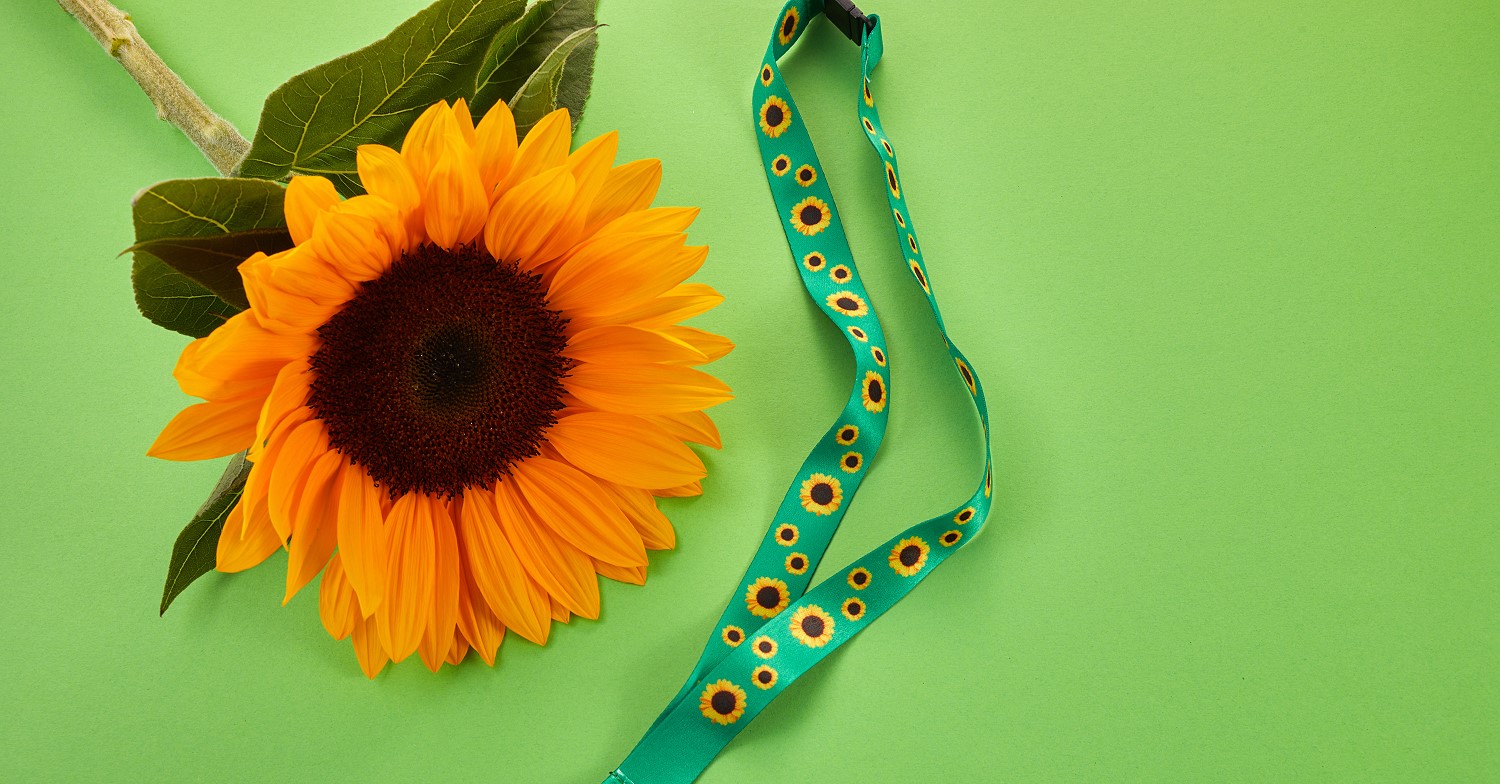
Green Sunflower Lanyard with a sunflower pattern alongside a sunflower, symbolizing invisible disabilities

The green lanyard with yellow sunflowers is an international symbol for people with non-visible disabilities or impairments. It was introduced in Britain in 2016 and is now used at many airports and in public facilities, among other places.

Wearing a Sunflower lanyard is voluntary. It lets others know that the wearer may need more time, understanding or support, without having to explain their disability or impairment. For example, the wearer may have autism, ADHD or another impairment that is not immediately apparent.

You can also wear the lanyard when visiting Disneyland Paris. However, we are not currently aware of Disneyland Paris officially taking part in the Sunflower programme. You cannot assume that all Cast Members are familiar with its meaning. The lanyard is also not proof of eligibility and does not replace either the Easy Access Card or the Priority Card. It can still be a useful aid. If you already have one or are thinking of getting one anyway, there is no reason not to wear it at Disneyland Paris too.

You can find more information about the symbol and the international programme on the official Hidden Disabilities Sunflower website.

The Blue Booklet and other official support

The Disneyland Paris Blue Booklet is a particularly useful source of information for your visit. Disney developed this booklet with autism specialists. It is aimed primarily at autistic people or people with cognitive impairments, and those accompanying them. Much of the information can also be useful for people with other forms of neurodivergence.

The detailed sensory assessments of attractions and restaurants are particularly interesting. Symbols indicate where you can expect loud noises, intense lighting effects, strong smells or numerous visual stimuli, for example. This makes it much easier to assess what to expect during your visit. The booklet also describes the evacuation conditions for each attraction.

The Blue Booklet also contains information on travelling to Disneyland Paris, security checks, visiting the Disney Parks and possible places to retreat to. It covers situations that can easily be overlooked when planning a visit.

Our tip: Download the Blue Booklet before your trip and look in particular at the attractions you really want to visit. The booklet is quite extensive. If you prefer reading on paper or would rather not keep searching on your smartphone during your visit, you can print out the most relevant pages. Copies of the Blue Booklet are available on site in English or French only. The German edition is free and available only as a download.

Download the Disneyland Paris Blue Booklet as a PDF

Disneyland Paris also provides dedicated accessibility maps for both Disney Parks and a general accessibility guide. These include information on access requirements and possible restrictions at individual attractions.

For people who use pictures and symbols to communicate, Disneyland Paris also offers a free image library. These images can be used to represent attractions, activities or daily routines, for example. They can also be incorporated into familiar communication aids.

Ear defenders are another practical aid available to borrow from Disneyland Paris. You need a valid Easy Access Card or Priority Card to borrow them. You can borrow them free of charge without a reservation, subject to availability.

You can find the official information materials and further details of the support available on the Disneyland Paris accessibility page.

Breaks and places to take time out

Even with good preparation, the amount of sensory input at Disneyland Paris may eventually become too much for you. It helps to know somewhere you can get a little distance from the bustle. However, there is music and noise almost everywhere in the Disney Parks, with people all around. Finding a genuinely quiet spot is not always easy. But there are a few ways to avoid sensory overload.

Official sources of support in the Disney Parks

If you need a longer break, returning to your hotel may be the most comfortable option. You can leave the Disney Parks and use your valid ticket to re-enter later that day. This gives you the option of returning after a longer break.

You can also turn to the first aid centres (First Aid) in both Disney Parks. You can ask for a quiet place to rest if you need one. The Cast Members can tell you what is available at the time.

However, the first aid centres will not always be nearby. If you need immediate support but the first aid centres are too far away, you can also ask a nearby Cast Member for help.

Quieter corners away from the busiest areas

As well as the official sources of support, there are a few places where you can get some distance from the crowds, at least for a while. The following suggestions are based on visitors’ personal experiences and our knowledge of the parks and surrounding area. These are not designated quiet zones. How busy or noisy they actually are depends on the time of day, visitor numbers and any events taking place.

In Disneyland Park:

  • Behind Cowboy Cookout Barbecue in Frontierland, there is an area where you can take some time out.
  • Liberty Arcade and Discovery Arcade run parallel to Main Street, U.S.A. and have some seating. Depending on the time of day and the weather, the arcades can also get busy at times.
  • Between Frontierland and Adventureland, there are a few corners away from the main paths where fewer visitors pass by. Bear in mind, though, that there are also toilets and a smoking area here.
  • The terrace at Cafe de la Brousse in Adventureland is usually not very busy, particularly when the snack bar is closed.
  • You can take a short break on the bridge between Adventureland and Fantasyland. The waterfall provides a steady background sound that some people find pleasant.
  • It is often a little quieter around Discoveryland station and in the adjoining passageway towards Fantasyland.

In Disney Adventure World:

  • Around Adventure Bay, there are paths and areas by the water where you can get a little distance from the crowds. However, it can get very busy and noisy here during shows and other events around the lake.
  • The path to Cars ROAD TRIP and the area in front of the attraction are often not particularly busy either, making them quieter than other parts of the park.

Outside the Disney Parks:

  • There is a walking path around Lake Disney with seating by the water. It can be relatively quiet here, particularly during the day when many hotel guests are in the Disney Parks.
  • The outdoor areas of some Disney Hotels are good places to take time out. These include the grounds of Disney Hotel Cheyenne, the terrace at Disney Sequoia Lodge and the outdoor areas at Disney Hotel Santa Fe.

Quieter places to eat

  • Hollywood Gardens Restaurant: Upstairs, you can sit a little away from the areas people walk through on the ground floor. However, the restaurant is in the busy World Premiere hall, so it can be noisy upstairs too.
  • Colonel Hathi’s Outpost Restaurant: The outdoor terrace in Adventureland is surrounded by plenty of greenery and has some quiet spots.
  • Cowboy Cookout Barbecue: In Frontierland, there is outdoor seating away from the busiest areas. There are also quieter corners inside the large barn. At peak mealtimes, though, it can get quite noisy.
  • Earl of Sandwich: This restaurant in Disney Village has an upstairs seating area overlooking Lake Disney. It is usually less busy there than downstairs.

At the fast food restaurants, you can also order your food using Mobile Order (although not every restaurant offers this service). Then you just need to collect it and can enjoy it either in the restaurant or in another quiet place.

Book a Disneyland Paris dream vacation